
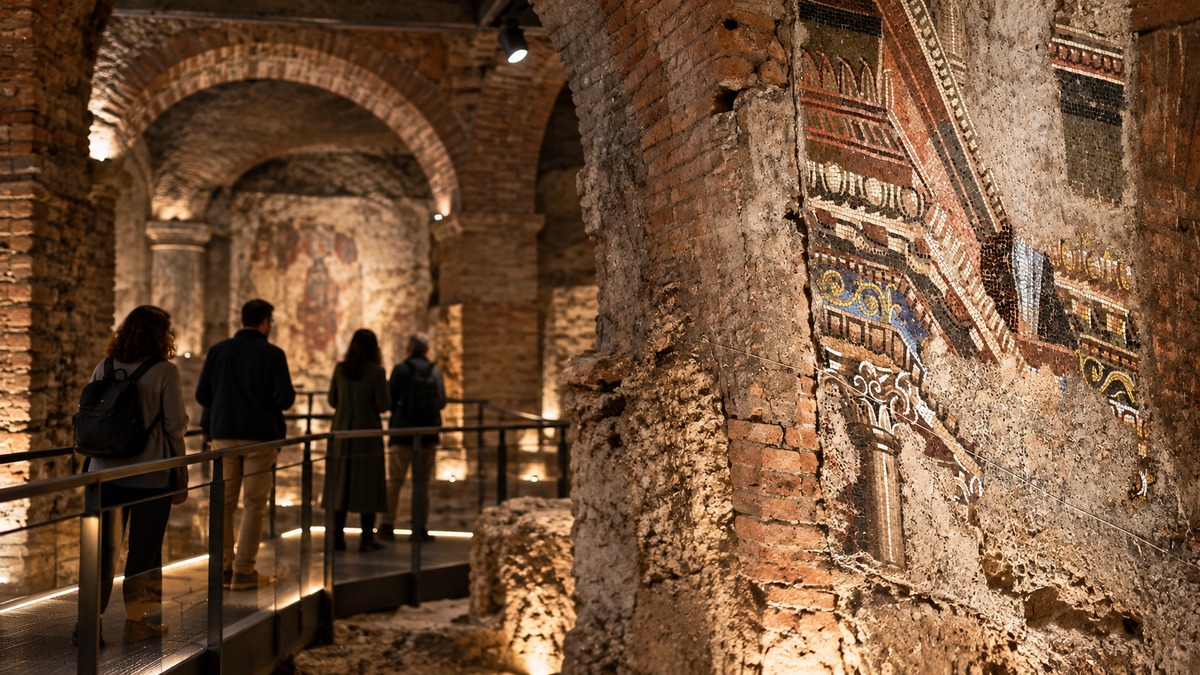
A short walk from the Colosseum, a new museum inside the Baths of Trajan opens the door to two ancient artworks that spent centuries hidden underground on Rome’s Oppian Hill.
- The Painted City fresco and the Great Mosaic, estimated to date to the first century A.D., are now on public view after restoration.
- The site sits within the Baths of Trajan, once the largest bath complex in the world, near the Colosseum.
- Early access runs in small reserved groups, with a regular Friday-to-Sunday schedule starting in October.
What Travelers Can Actually See
Rome rarely runs short on ancient wonders, yet even here a fresh discovery can turn heads. On the Oppian Hill, a new museum has opened inside the Baths of Trajan, and it puts two remarkable works of ancient art within reach of visitors for the first time. Both were found underground during excavations in the 1990s, and both had been sealed away from view for a very long time.
The two headliners are the Painted City fresco and the Great Mosaic. The fresco covers about ten square metres and belongs to a building that predates the baths themselves. It shows a city viewed from above, and even after all this time its blues and terracotta tones still read clearly, though they’ve faded with age.
The mosaic is the showstopper by scale. Its imagery spreads across four levels. Near the top you get close-up scenes with figures arranged almost like a stage set. Lower down, the view shifts to a bird’s-eye look at a port city’s layout. Known as “The Muse and the Philosopher,” the mosaic sits in a large hall that once overlooked a nymphaeum and depicts a Roman harbour in fine detail. Scholars aren’t sure whether the harbour is real or imagined, and some have wondered whether it ties to Emperor Claudius.
A Bath Complex Built for Scale
The setting is a story in itself. The Baths of Trajan were dedicated by Emperor Trajan and inaugurated on 22 June, 109 A.D. Designed by Apollodorus of Damascus, they covered around 60,000 square metres, or roughly six hectares, and ranked as the biggest bath complex anywhere at the time. Beyond the pools, the grounds held porticoes and spaces for exercise, culture, and general leisure.
The builders folded older structures into the plan, including part of the Domus Aurea, which is why the site now offers such a readable slice of layered Roman history. The complex was also laid out on a particular orientation to make the most of water temperatures, a small detail that says a lot about how carefully the baths were engineered.
Restoration and New Ways to Explore
Restoration did more than clean the artworks. Excavation beneath the decoration revealed that the original hall was far taller than it appears today, with walls thought to have risen to around 12 metres. Visitors can now take in the philosopher figure and other finely rendered characters in the exposed section.
The wider project added panoramic rest areas and new pedestrian routes through the grounds. There’s also a tiered seating setup meant to host concerts, conferences, and events, so the space is built to work as more than a static display.
How to Plan a Visit
Access is deliberately limited to protect the art. The earliest visits were arranged as an experiment for small groups on weekends only, with free guided tours by reservation beginning on 12 and 13 September. From 2 October, the site opens to visitors Friday through Sunday. Expect six time slots a day, each capped at 15 people.
Those caps matter if you’re mapping out a Rome itinerary. This is a reservation-first experience rather than a walk-up stop, and the small group sizes mean spaces can fill. Booking arrangements can shift, so it’s worth confirming the current schedule and reservation details before you lock in a date.
Worth the Detour
For anyone already circling the Colosseum, the Baths of Trajan add a quieter, more intimate chapter to the usual Rome checklist. Seeing ancient art that spent centuries out of sight is the kind of moment that rewards a little planning. Reserve early, keep your schedule flexible, and give yourself time to look closely.
