
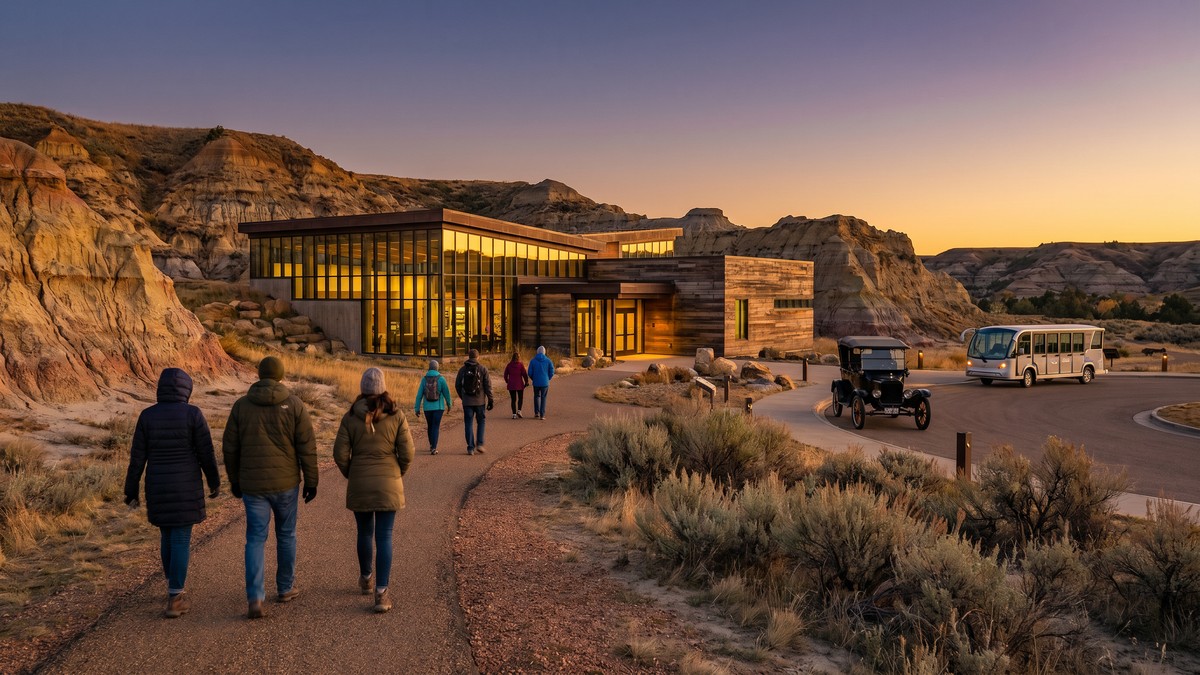
More than a century after his death, the 26th president is finally getting a library of his own, and it sits far from the East Coast in the wide open grasslands that shaped him. Travelers are already making the trip to Medora, North Dakota, to see a $450 million building that looks less like a museum and more like part of the land itself.
- The 96,000-square-foot library opened July 4 in the North Dakota Badlands, near Theodore Roosevelt National Park.
- Its grass-covered roof includes walking paths that lead to sweeping views of the surrounding buttes.
- An AI avatar lets visitors hold a real conversation with a digital version of Theodore Roosevelt.
A Building That Rises From the Prairie
Theodore Roosevelt consistently ranks among the country’s five most popular presidents, yet he spent 107 years after his death without a library to call his own. That finally changed this July, and the location surprises almost everyone who hears about it. Instead of his native New York, T.R.’s library rises out of the prairie grass in the Badlands, a landscape that meant everything to him. Readers interested in the broader context can also explore city-break destinations built around culture.
Architect Craig Dykers designed the building to feel like it grew out of the ground. Its gently sloping roof mimics the shape of the surrounding buttes, covered in native grasses and lined with walking paths. Yes, the roof has trails you can walk. The idea is to get visitors up and out for a commanding view of Theodore Roosevelt National Park right next door. Dykers wanted something that felt primitive, a form that seems to have simply arrived from the Earth.
Inside, a string of skylights supplies nearly all the natural light the space needs, and the walls are made from compressed earth. During an early look at the building, it was hard to tell where nature stopped and the library began. For the small town of Medora, the $450 million project is the biggest thing residents have ever seen. For authoritative background, the Theodore Roosevelt Presidential Library offers useful context.
Why North Dakota and Not New York
The location traces back to one of the hardest chapters of Roosevelt’s life. On Valentine’s Day 1884, his mother, Mittie, and his young wife, Alice, died in the same house on the same day. He wrote in his diary that the light had gone out of his life, marking the date with a bold X. After a double funeral and arranging for his sister to raise his newborn daughter, he headed West alone.
Edward O’Keefe, the library’s CEO and author of a recent book on Roosevelt, describes a young man remaking himself on the plains. Roosevelt had grown up sickly and asthmatic, living through books and imagination. In the Badlands, at 24 years old, he started living the rugged life he had only read about. As O’Keefe puts it, he was a broken man in a broken land, and nature became his healer. Roosevelt later credited those years with making his presidency possible.
History Meets New Technology
This is the kind of place that could not have been built even five years ago. Artificial intelligence runs through much of the experience. The library created what O’Keefe calls the world’s first presidential archive in AI, letting guests hold an in-person conversation with an avatar of Roosevelt. Come unprepared and, fittingly, he will not go easy on you. Another exhibit uses AI to show visitors what they might look like dressed in T.R.’s cowboy garb.
The rest of the grounds lean into adventure. It is the only presidential library with hitching posts for your horse. You can walk a mile-long path through the prairie, sit by a campfire and hear tall tales of range life, or step into a version of his cabin at the Elkhorn Ranch.
Facing the Full Legacy
Roosevelt’s descendants wanted honesty, not a glow-up. His great-great-grandson, Theodore Roosevelt V, said the goal was to face hard issues head-on rather than simply celebrate a great man. That includes Roosevelt’s racist views of Indigenous peoples. The team held a land blessing with five tribes to bring their voices into the project. The library has also taken possession of a Roosevelt statue removed in 2022 from the American Museum of Natural History, which critics said symbolized racial superiority.
Plan a Trip That Sticks With You
If the library carries one message, it is that courage often grows out of tragedy, mistakes, and misunderstanding. Roosevelt believed the credit belongs to the person in the arena, the one who tries and fails rather than the critic on the sidelines. For anyone drawn to history, wide landscapes, or a good story of reinvention, Medora just became one of the more compelling stops in the country. Pair the visit with the national park next door, and give yourself a full day to take it all in.
