
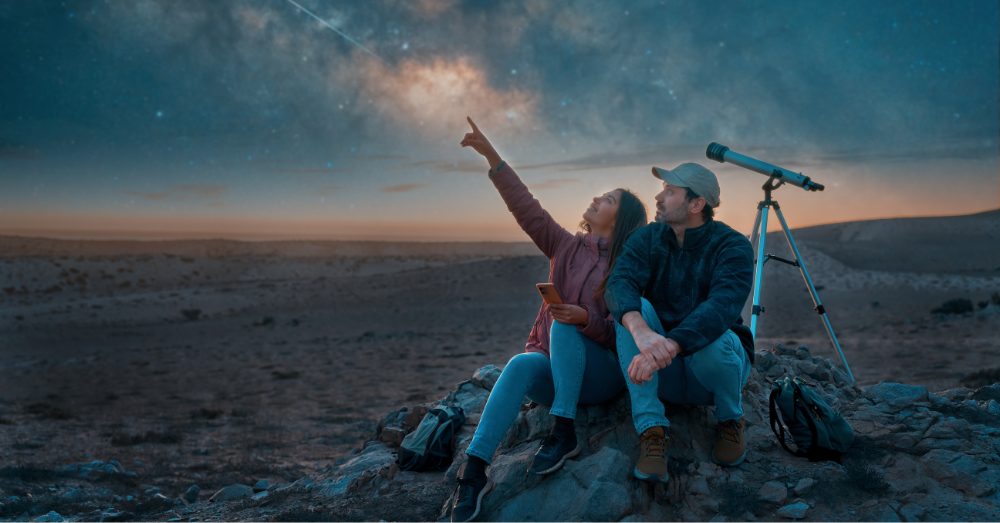
Forget beach chairs and city tours. The travel world has turned its eyes upward, and what travelers are finding in the night sky is changing how we think about a vacation. From cruise ships doubling as floating observatories to desert hotels built around telescopes, astro-tourism has gone from niche hobby to mainstream travel trend for 2026.
- Astro-cruising combines ocean voyages with stargazing sessions led by professional astronomers, with ships dimming lights to create optimal viewing conditions far from city glow.
- Observatory hotels like Hotel Rangá in Iceland and Compass Rose Lodge in Utah feature on-site telescopes and astronomy programs, turning accommodations into cosmic experiences.
- Desert astronomy road trips through places like Utah’s Dark Sky Parks and Nevada’s Park to Park in the Dark route offer some of the clearest night skies on the planet.
Cruise Ships Are Turning Into Floating Planetariums
The ocean at night offers something cities can’t: darkness. When a ship is at sea, the only light anywhere comes from the ship itself. On a stargazing cruise, the captain will dim as many of the ship’s lights as legally allowed, creating an incredibly dark setting. Ships like Royal Caribbean’s Quantum of the Seas and Star of the Seas feature onboard observatories, astronomy lectures and special Lights-Out deck hours for stargazing.
Atlas Ocean Voyages introduced stargazing and astronomy workshops on select 2024 and 2025 expeditions and will feature two solar eclipse cruises in 2026. Astrotourism has been taking off in recent years, with the next few years expected to deliver some of the most awe-inspiring auroras, solar eclipses, constellations and comets.
What makes astro-cruising different from landlocked stargazing? You’re never far from comfort. Stargazing on a cruise ship is unique, because the vessel can travel to locations completely devoid of light pollution, and yet viewers are never more than a few steps away from the ship’s accommodations. Trip astronomers prepare passengers beforehand, and while the ship is in motion so using a telescope isn’t practical, binoculars work perfectly for viewing the spectacular night sky with guided observing sessions.
Hotels Built for the Stars
Some hotels come with an entire observatory as a standard feature. Hotel Rangá’s on-site observatory is equipped with high-quality telescopes and a custom-built roll-off roof, and on clear nights, the hotel’s resident astronomer guides guests on a tour of the starry sky. The remote Iceland location means guests can combine northern lights watching with deep-sky observation.
In Huntsville, about 45 minutes from Salt Lake City, the Compass Rose Lodge is home to the Huntsville Astronomic and Lunar Observatory (HALO), which is set up inside a silo with a retractable roof. The lodge sits at the edge of International Dark Sky Association designated North Fork Dark Sky Park, an area in the Ogden Valley that’s worked hard to preserve its night skies by limiting light pollution.
Adero Scottsdale sits 2,500 feet above the Sonoran Desert in Fountain Hills, one of 38 International Dark Sky Communities around the world, and the town is home to the International Dark Sky Discovery Center, which features an astronomical observatory and planetarium. The resort employs shielded lighting and uses nonreflective paint to minimize its own light pollution impact.
For travelers in Columbus, Ohio, planning a dark sky adventure means looking west to places like Colorado’s Kosmos Stargazing Resort or south to the growing network of observatory hotels reshaping mountain and desert regions into cosmic viewing platforms.
Desert Road Trips Under a Billion Stars
Since light pollution steals the spectacle of stargazing in most communities, Dark Sky Park road trips are the new after-hours party, with the Park to Park in the Dark Road Trip between Death Valley National Park and Great Basin National Park showering you with celestial showcases.
Park to Park in the Dark is Nevada’s first astronomy route to promote dark skies and outdoor recreation at night, following US-95 and US-6 through five rural towns between Death Valley in California and Great Basin in Nevada. Both parks have “Gold Tier” status, meaning you can experience some of the darkest skies on the planet.
Utah claims bragging rights as the stargazing capital of America. Utah boasts the highest concentration of DarkSky International-certified parks, communities and protected areas in the world, with remote geography, high elevation, and an arid climate combining with dedicated protection efforts to create perfect viewing conditions. A road trip through southwest Utah takes you to four of the state’s best places to see the Milky Way: Capitol Reef National Park, Kodachrome Basin State Park, Bryce Canyon National Park and Cedar Breaks National Monument.
Joshua Tree National Park is California’s most celebrated Dark Sky Park and one of the best stargazing spots in the US to see the Milky Way during summer months, with optimum viewing when there is no moon or when the moon is not too high in the sky.
Light Pollution: The Enemy of Stargazers
With light pollution increasing by 10% every year and an estimated 80% of the world population impacted by it, fewer and fewer people have regular access to a truly dark night sky. So how do you escape it?
The simplest metric is called the Bortle scale, which qualifies light pollution by classes 1-9, with Harvard straddling classes 8 and 9, and most astronomers recommending trying to get to at least Class 4 skies to make a trip worth it. Free online maps like lightpollutionmap.info show where light pollution is lower.
The best stargazing conditions occur during a new moon or when the moon is below the horizon, with experts recommending avoiding full moon periods as the bright moonlight can obscure many stars. Winter is the best time of year because there are longer hours of darkness, and the air tends to be clearer.
Once you’ve found your dark sky location, protecting your night vision matters. Be respectful of other stargazers by using only red torch lights, which preserve night vision and protect wildlife, and don’t shine torches or phone screens at others as it can take 20 minutes for eyes to re-adjust to darkness after exposure to light.
Why Now? The Perfect Storm for Star-Chasers
Astro-tourism is quickly becoming one of travel’s most exciting frontiers for 2026, with the trend now blending cosmic fascination with immersive experiences, from dark-sky adventures to space-themed attractions, and searches for dark-sky tours and space-themed experiences increasing by 1,040% and 79% respectively.
The timing couldn’t be better. The latest travel trend as we build up to the total solar eclipse on August 12, 2026, is a view of the night sky. Travel company Intrepid says its Solar Eclipse Tours in partnership with New Scientist for Spain 2026 are sold out, with bookings mostly coming from midlife travellers and multi-generational families.
Technology has made participation easier too. Apps like SkySafari, Star Walk and Dark Sky Map help identify constellations from your phone. Hotels loan out binoculars and telescopes. Professional astronomers lead sessions that demystify the cosmos. Whether you’re an astronomy veteran or complete beginner, the experience is accessible to everyone who shows up and looks up.
As Joanna Reeve, UK director at Intrepid, notes, “Astrotourism allows people to connect with nature at a time when the world feels more online than ever.”
Planning Your First Astro-Adventure
Start by choosing your format. Want the comfort and convenience of a cruise? Look at Royal Caribbean’s Night Sky Programming or Atlas Ocean Voyages’ astronomy workshops. Prefer a home base with expert guidance? Observatory hotels like Hotel Rangá or Compass Rose Lodge offer nightly viewings with resident astronomers.
For the adventurous, desert road trips through Death Valley, Great Basin, or Utah’s Dark Sky Parks provide the rawest, most authentic experience. Pack warm layers because desert nights get cold, and download astronomy apps before you lose cell signal.
Certified Dark Sky Places are required to use quality outdoor lighting, effective policies to reduce light pollution, ongoing stewardship practices, and more. DarkSky International has certified locations as having the highest quality night sky, with roughly 150 Dark Sky Places in the US falling into five categories: parks, sanctuaries, reserves, communities and urban night sky places.
Check the lunar calendar and aim for new moon phases. Verify weather forecasts using sites like clearoutside.com. Bring binoculars because they’re more practical than telescopes for beginners and work great on moving ships. Pack red flashlights to preserve night vision. Most of all, give your eyes time to adjust. That first 20 minutes of darkness reveals progressively more stars as your vision adapts.
The universe has been there all along. We’re finally learning to see it again.
